
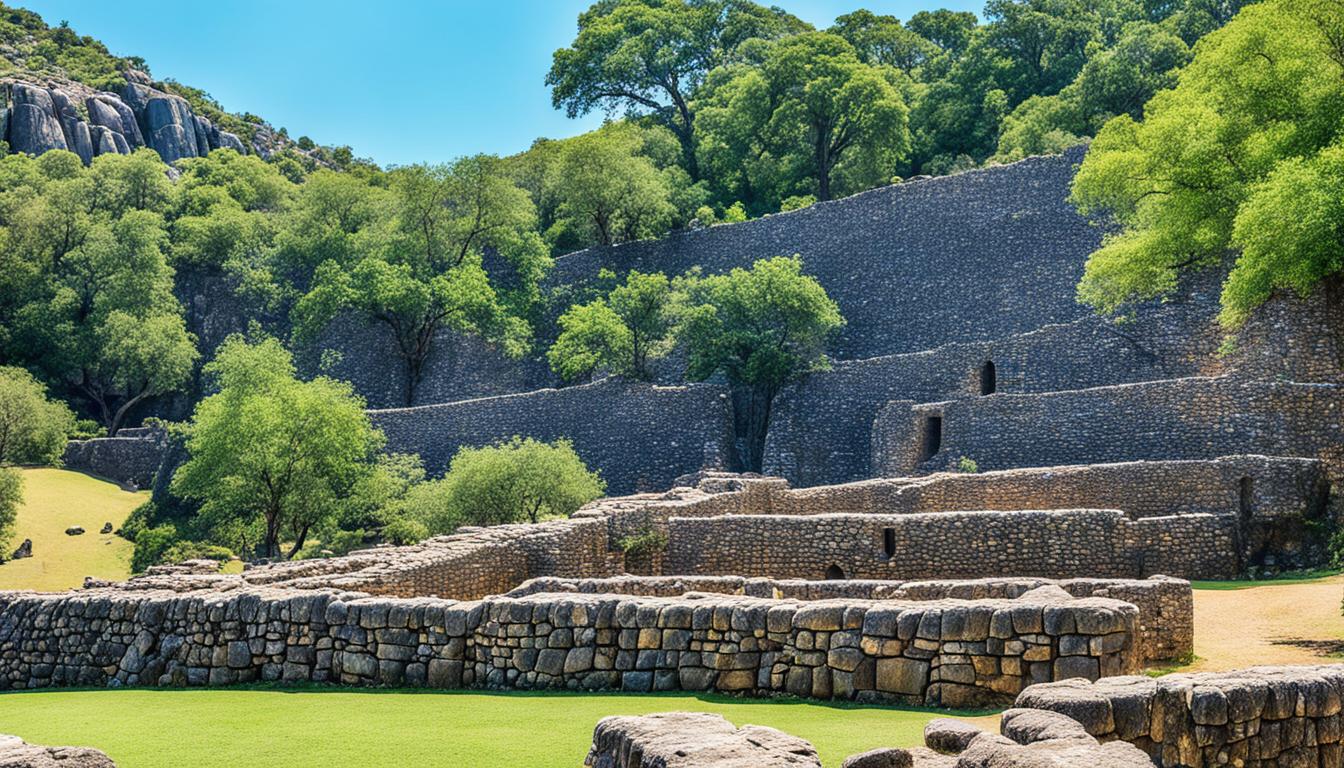
Great Zimbabwe is the largest and best known of southern Africa’s ancient stone cities. The site stands about 30 kilometers from the town of Masvingo in Zimbabwe. UNESCO lists it as a World Heritage Site. The ruins cover almost 800 hectares and were built between 1100 and 1450 AD.
The site has three main parts. The Hill Ruins sit on a granite outcrop and were lived in from the 11th to the 15th centuries. Archaeologists think this was the royal area. Six stone posts carved with birds were found here, and the bird has become a national symbol. The Great Enclosure below the hill dates to the 14th century. It was built from cut granite blocks laid without mortar and includes a tall conical tower. The Valley Ruins hold the remains of houses and workshops where most people lived.
Great Zimbabwe was the center of a trading state. Imported goods found at the site show it was tied into long-distance trade networks that reached the Indian Ocean coast and beyond. At its height the city was the capital of a major trading power. The Great Enclosure is often described as the largest ancient stone structure south of the Sahara.
Early European visitors refused to believe Africans had built the walls and credited foreign builders instead. Later research showed the work was done by the ancestors of the Shona people, who built the city between the 11th and 15th centuries. During the Rhodesian era the authorities suppressed this history in guidebooks and school materials. After independence in 1980 the country took its name from the site, and the Zimbabwe bird appears on the national flag.
The site is managed by the National Museums and Monuments of Zimbabwe. Visitors can walk the Hill Ruins, the Great Enclosure, and the Valley Ruins with a guide. Anyone interested in African archaeology can also read about Nile Valley archaeology in Sudan. For the country’s modern academic scene, see higher education in South Africa, and for a neighboring country’s story, higher learning in Zambia.