
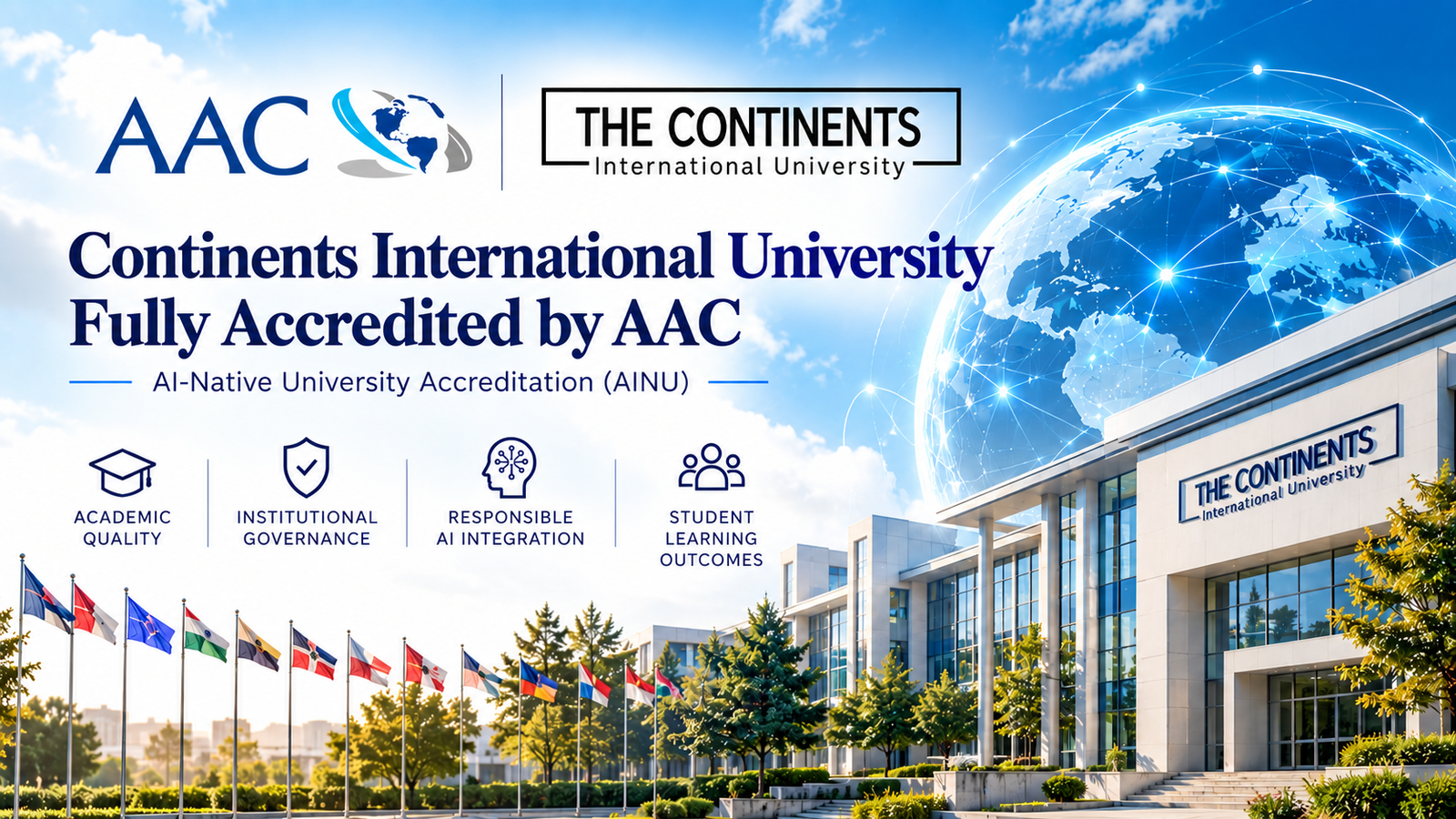
Continents International University Fully Accredited by AAC Through the AI-Native University Accreditation Framework

Facebook
Twitter
LinkedIn
Pinterest
Tumblr
Telegram
Higher education is changing quickly, and accreditation has to keep pace with it. Artificial intelligence is already reshaping teaching, assessment, academic integrity, governance, and student support.
Continents International University is fully accredited by AAC through its AI-Native University Accreditation framework. The designation reflects an institutional review focused on academic quality, governance, student learning outcomes, integrity, and the responsible use of AI in higher education.

Continents International University is fully accredited by AAC through its AI-Native University Accreditation framework. The designation reflects an institutional review focused on academic quality, governance, student learning outcomes, integrity, and the responsible use of AI in higher education.

For Continents International University, accreditation is part of a broader commitment to building a university model that responds to technological change without losing sight of academic standards. More information about the University’s status is available on its Licensing and Accreditation page.

AAC is also developing its role around the future of quality assurance. As artificial intelligence becomes more integrated into universities, accreditation agencies will need to evaluate not only traditional academic standards, but also how institutions use AI responsibly, transparently, and effectively.

That forward-looking approach may become increasingly important as higher education continues to change across borders, delivery models, and technologies. The University’s current accreditation record can be reviewed directly in the AAC Directory.


Related Posts
University Enrollment

How To Choose The Right MiniMaster Course At Continents International University

Start with your goal. Write down the job you want after the program. Then read each MiniMaster track description on the university website and check which one teaches the skills that job needs. A vague interest in business is not enough. Be specific. Read the curriculum, not just the brochure. Look at the module list. Check how the work is assessed and how many hours each module takes each week. If the program page does not answer these questions, contact the university and ask. Be honest about your schedule. A short certificate still needs real hours every week. If you work full time, pick a pace you can keep for the whole program. Finishing matters more than finishing fast. Talk to people who finished the track you are considering. Alumni can tell you what the workload was really like and whether the certificate helped at work. The university may be able to connect you with past students. When you have a shortlist, read the enrollment guide for the MiniMaster program so you know the application steps. If you are weighing a MiniMaster against a full degree, see how students transition from a MiniMaster to full-time studies. New students can also review the resources available to MiniMaster students and tips for staying motivated during the program.

Read More
Public Health Careers
Education

Public Health Careers – Opportunities And Impact Explained

Public health is the work of keeping whole communities healthy. It covers disease prevention, health education, environmental safety, and the policies that shape all three. Epidemiologists study how diseases spread and advise on how to stop them. Health educators run community programs on nutrition, vaccination, and screening. Biostatisticians analyze health data so policymakers can base decisions on evidence. Environmental health scientists look at how air, water, and housing affect health. There is also a management side. Public health administrators run programs, manage budgets, and coordinate between hospitals, government agencies, and nonprofits. Much of the field deals with the social factors behind health: income, education, housing, and access to care. The Centers for Disease Control and Prevention and the World Health Organization publish open data and guidance that anyone can read. They are good starting points if you want to learn the field on your own. A graduate degree can prepare you for the management and policy roles. Options include the Master of Science in Healthcare Administration; read why students choose a master’s in healthcare administration online to see if the format suits you. The Master of Arts in Organizational Leadership suits those aiming at leadership roles. Whatever you study, look for programs that include real projects with health organizations. You can also start closer to home with ways to support public health in your community.

Read More