
Central American Federation’s Academic Triumph: Navigating Education

Facebook
Twitter
LinkedIn
Pinterest
Tumblr
Telegram
Central American Federation's Academic Triumph: Navigating Education
Explore the Central American Federation's Academic Triumph, showcasing strides in Navigating Education towards a brighter future.

There is no Central American Federation today. The Federal Republic of Central America was a short-lived 19th-century union formed in 1823 after independence from Spain and a brief annexation by Mexico. It adopted a constitution in 1824, fell into civil wars, and dissolved in the late 1830s, with the federation fully collapsing by 1841. Any article that presents the federation as a current education authority is describing something that does not exist.

Education in the region today is run by national governments in Guatemala, El Salvador, Honduras, Nicaragua, Costa Rica, and Panama. Quality and resources vary widely between and within these countries, and students often compare local universities with options abroad.

For students considering international study, the usual checks apply: confirm accreditation, compare total costs, and make sure a degree will be recognized where you plan to work. studying abroad or attending a local college, crafting a strong study abroad application, and study abroad programs in Europe can help with the decision and the application.

Online programs have widened access for students in the region, though cost and connectivity remain real barriers. Focus on legitimate, recognized programs rather than on any organization claiming to represent a federation that ended nearly two centuries ago.

Related Posts
Higher education is changing quickly, and accreditation has to keep pace with it. Artificial intelligence is already reshaping teaching, assessment, academic integrity, governance, and student support.
Awareness

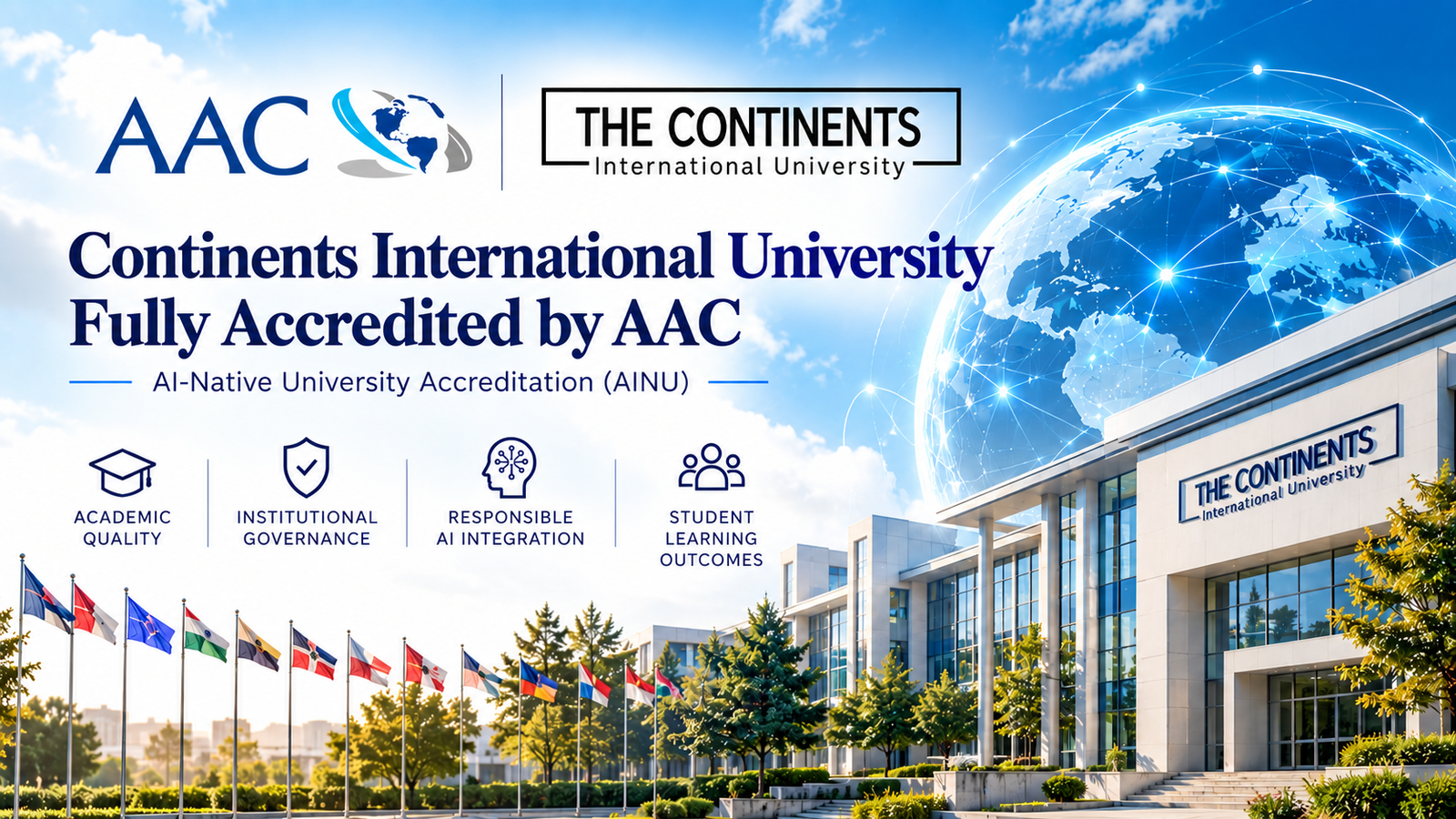
Continents International University Fully Accredited by AAC Through the AI-Native University Accreditation Framework

Continents International University is fully accredited by AAC through its AI-Native University Accreditation framework. The designation reflects an institutional review focused on academic quality, governance, student learning outcomes, integrity, and the responsible use of AI in higher education. For Continents International University, accreditation is part of a broader commitment to building a university model that responds to technological change without losing sight of academic standards. More information about the University’s status is available on its Licensing and Accreditation page. AAC is also developing its role around the future of quality assurance. As artificial intelligence becomes more integrated into universities, accreditation agencies will need to evaluate not only traditional academic standards, but also how institutions use AI responsibly, transparently, and effectively. That forward-looking approach may become increasingly important as higher education continues to change across borders, delivery models, and technologies. The University’s current accreditation record can be reviewed directly in the AAC Directory.

Read More
Awareness

Problem with Outdated University Education

University courses are only useful if they keep up with the field. Textbooks take years to write and publish. Curriculum review boards move slowly too. In fast-moving subjects like technology, health care, and public policy, a syllabus written five years ago can leave students studying ideas the industry has already moved past. This gap matters because employers hire people who can use current methods, not old ones. Students can graduate, start work, and find that their training does not match what the job requires. The cost falls on the graduate. Universities close this gap by reviewing course content often instead of waiting for a full curriculum overhaul. They check reading lists against recent research. They bring working professionals in to teach and advise. They ask graduates and employers what the program missed. Schools that do this through curriculum design that responds to feedback stay relevant longer. Students can protect themselves before enrolling. Ask when the course materials were last updated. Read the reading list and check the publication dates. Ask whether the program consults industry advisers, and what a competency-based curriculum looks like in practice. A school that cannot answer these questions is not paying attention to the problem. Before choosing any program, review how to judge whether a curriculum fits your goals. And consider delivery format as well: flexible online learning can make it easier to study while working, which matters most when the content is current.

Read More