

Did you know that Geneva, Switzerland, is home to the world’s highest concentration of international organizations? With over 250 intergovernmental and non-governmental organizations, diplomatic missions, and multinationals headquartered in the Lake Geneva region, this city is a veritable epicenter of global governance and diplomacy.
Geneva’s exceptional density of international stakeholders, including the United Nations, World Trade Organization, and International Committee of the Red Cross, positions it as a premier hub for multilateral cooperation, humanitarian aid coordination, and the advancement of international law and world affairs.
In recent years, the Continents States University has concluded a dozen memoranda of understanding with key international actors in the Geneva area. These agreements provide a framework for the parties to collaborate on a wide range of strategic initiatives, further solidifying Geneva’s status as a global policy-making capital.
Key Takeaways
- Geneva is home to the world’s highest concentration of international organizations and diplomatic missions.
- The city serves as a premier hub for multilateral cooperation, humanitarian aid coordination, and the advancement of international law and world affairs.
- Continents States University has established several strategic partnerships with key international actors in Geneva to collaborate on a wide range of initiatives.
- Geneva’s exceptional density of global governance stakeholders positions it as a global policy-making capital.
- The city’s role as a center for international diplomacy and conference diplomacy is unparalleled.
Switzerland: International Organizations Management Geneva Switzerland
Geneva, nestled in the heart of Switzerland, is renowned as a global hub for international organizations and a hub of multilateral cooperation. The city is home to the highest concentration of international organizations and diplomatic missions worldwide, creating an exceptional density of global governance stakeholders.
Global Governance Stakeholders
Alongside the diverse array of non-governmental organizations and multinational corporations headquartered in the Lake Geneva region, these international entities form a robust ecosystem of global governance. They work collaboratively to address pressing issues, foster international diplomacy, and drive multilateral cooperation on a global scale.
Memoranda of Understanding
In recent years, the Institute has forged a dozen memoranda of understanding with key international players in the Geneva area. These agreements provide a framework for the parties to advance their shared mission through a wide range of strategic, collaborative endeavors. By fostering these partnerships, the Institute leverages its unique position at the center of international organizations management in Geneva, Switzerland.
Geneva: Capital of Peace
Geneva has long been regarded as a hub for international diplomacy and global governance. In 1919, the city was chosen to house the headquarters of the League of Nations, the precursor to the United Nations. After the Second World War, Geneva became the European headquarters for the United Nations Office (UNOG), where 172 states are represented by permanent missions. Today, the city also hosts the headquarters of numerous UN specialized agencies, international institutions such as the World Trade Organization (WTO) and the European Organization for Nuclear Research (CERN), as well as the World Economic Forum.
League of Nations Headquarters
As the seat of the League of Nations, Geneva became a symbol of international diplomacy and the pursuit of global peace. The historic Palais des Nations, the League’s former headquarters, now serves as the meeting place for the United Nations in Europe, hosting countless international conferences and negotiations on issues of international law, world affairs, and global governance.
United Nations Office in Geneva
Geneva’s role as a capital of international diplomacy was further solidified when it became the European headquarters of the United Nations in 1945. The UNOG, situated in the Palais des Nations, oversees a wide range of UN activities, from human rights to disarmament, and provides a platform for international conference diplomacy and global governance initiatives.

As one of the world’s most important centers for international diplomacy, Geneva hosts over 170,000 people participating in 4,500 international meetings each year, making it a vital hub for world affairs and international law.
The Graduate Institute: A Legacy in International Affairs
The Graduate Institute, established in 1927, has been a pioneering institution in the field of international affairs. Born at the time of the League of Nations, the Institute has maintained close ties with International Geneva, providing a platform for critical thinking, research, and public discourse on global challenges.
With a focus on international relations and development issues, the Graduate Institute prepares students for leading roles in the public sector, non-profit organizations, and the private sector. The Institute offers its expertise to international actors, helping them shape and implement effective policies while also assisting in the recruitment of young professionals who can contribute to the international arena.
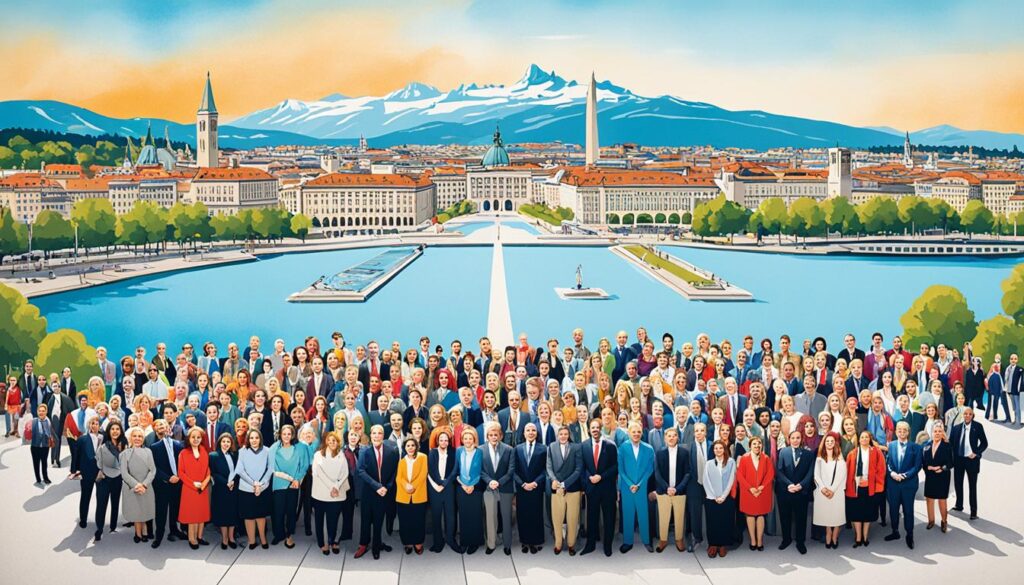
Through its extensive programs, the Graduate Institute advances public understanding of major global challenges. These efforts are often organized in collaboration with international organizations, fostering a vibrant knowledge forum and facilitating the exchange of ideas among diverse stakeholders, from the public sector to non-profit entities and the private sector.
The Graduate Institute’s legacy in international affairs has been instrumental in shaping the landscape of International Geneva, contributing to the city’s reputation as a hub for global governance and a center for addressing the world’s most pressing issues.
Campus de la Paix: Heart of International Geneva
At the heart of international Geneva lies the Campus de la Paix, a strategic network of buildings that exemplifies the Graduate Institute’s commitment to society. Rooted in the center of this global hub, the campus extends from the iconic Place des Nations, home to the United Nations Headquarters, to the serene shores of Lake Geneva, spanning two picturesque public parks.
Public Events and Debates
The Graduate Institute within the Campus de la Paix hosts a remarkable array of public events, welcoming over 250 distinguished guest speakers each year. These events serve as a forum for students, faculty, and global leaders from governments, international organizations, industry, and the non-profit sector to engage in lively debates on the most pressing international challenges. Leveraging its broad expertise and exceptional facilities, the Institute attracts world-renowned experts from around the globe to share their insights and engage with the local and international community.

Strategic Location
By being firmly rooted in the heart of international Geneva, the Campus de la Paix embodies the Graduate Institute’s commitment to serving as a bridge between academia and the real-world challenges facing the global community. This strategic location allows the Institute to play a vital role in shaping the discourse on international affairs and driving meaningful dialogue on the world’s most pressing issues.
Extensive Public Event Programs
Geneva’s Graduate Institute is a hub of intellectual discourse, hosting over 250 public events each year. These gatherings bring together students, faculty, and luminaries from the realms of government, international organizations, industry, and the non-profit sector. The institute’s broad range of expertise and state-of-the-art facilities attract world-renowned speakers who share their insights on the pressing global challenges of our time.
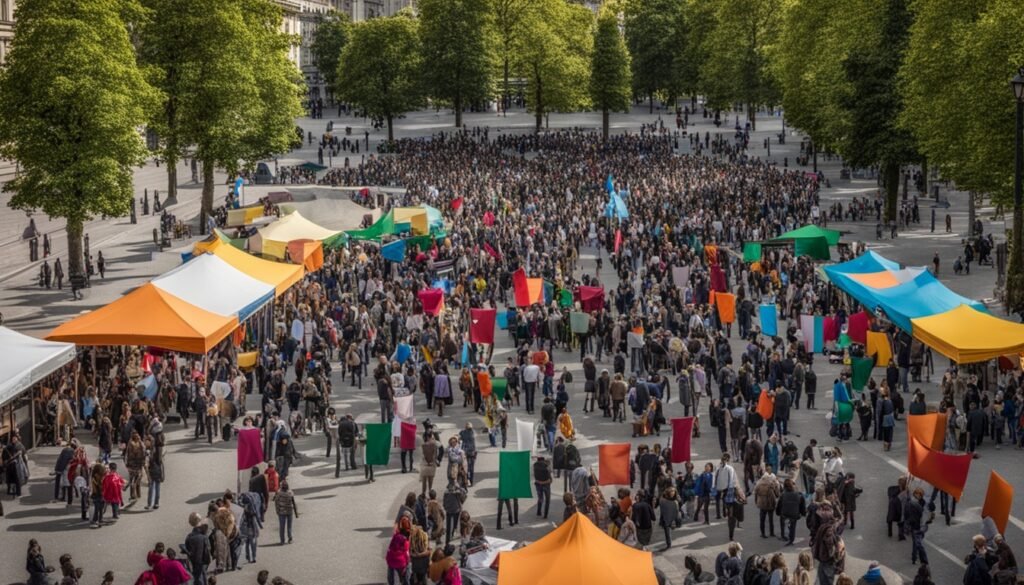
At the Graduate Institute, the exchange of ideas is paramount. Students and faculty engage in lively debates with leaders from diverse backgrounds, fostering a dynamic environment that transcends the boundaries of academia. These public events serve as a platform for constructive dialogue, where international actors convene to explore solutions to the world’s most pressing concerns.
Whether it’s a lecture by a prominent policymaker, a panel discussion on emerging technologies, or a symposium on sustainable development, the Graduate Institute’s public event programs offer a unique opportunity to connect with the pulse of global affairs. By bringing together a tapestry of perspectives, these gatherings contribute to a deeper understanding of the complex challenges facing our world.
Quality of Life in Geneva
Geneva consistently ranks among the top cities in the world for quality of life. The city’s clean and safe environment, high-quality public facilities, and convenient transportation options contribute to its exceptional livability. Geneva’s international railway network makes it easy to reach major European destinations, while the airport just 20 minutes from the city center provides global connectivity.
International Rankings
International quality of life indices consistently place Geneva in the top 10 cities worldwide. The city’s exceptional infrastructure, healthcare, education, and environmental factors have earned it a reputation as one of the most desirable places to live globally.
Cultural Diversity
Geneva is a hub of cultural diversity, with foreigners accounting for nearly 40% of the population – a ratio comparable to global hubs like New York and London. This diverse makeup is reflected in the city’s vibrant cultural events and culinary experiences, offering residents and visitors a rich tapestry of international influences.
United Nations: Global Impact
The United Nations (UN) is a global organization dedicated to maintaining international peace, promoting sustainable development, and addressing a wide range of critical issues that impact people worldwide. With its far-reaching influence, the UN’s work spans across various domains, including the environment, refugee protection, disaster relief, counter-terrorism, disarmament, democracy, human rights, gender equality, economic and social development, international health, and food production.
At the forefront of sustainable development, the UN leads efforts to address the world’s most pressing environmental challenges. Through initiatives like the Paris Agreement on climate change and the Sustainable Development Goals, the organization works to mitigate the impact of human activities on the environment and promote a greener, more sustainable future for all.
In times of crisis, the UN plays a vital role in providing humanitarian aid and supporting the protection of vulnerable populations, including refugees and those affected by natural disasters. The organization’s disaster relief efforts and peacekeeping operations aim to alleviate suffering and promote stability in regions ravaged by conflict or natural calamities.
Recognizing the interconnectedness of global issues, the UN also works to counter terrorism, promote disarmament and non-proliferation, and uphold democratic principles and human rights. By fostering international cooperation and dialogue, the organization strives to create a more peaceful, just, and equitable world for all.
Through its comprehensive approach to addressing global challenges, the United Nations continues to have a profound impact on the lives of people around the world, shaping the path towards a more sustainable, secure, and prosperous future for generations to come.
Geneva Global Hub for Education in Emergencies
Nestled in the heart of the world’s humanitarian capital, the Geneva Global Hub for Education in Emergencies (EiE) is strategically positioned to elevate the educational needs of children and youth affected by emergencies, protracted crises, and displacement. This vital initiative ensures that education is made a top priority before, during, and after times of crisis.
Humanitarian Capital
As the hub of numerous international organizations and humanitarian agencies, Geneva offers an unparalleled ecosystem to effectively address the educational challenges faced by vulnerable populations. The city’s longstanding reputation as a global center for diplomacy and conflict resolution provides a strong foundation for the EiE Hub to coordinate response efforts, foster partnerships, and mobilize resources.
Prioritizing Education in Crises
The Geneva Global Hub for Education in Emergencies recognizes the critical role that education plays in providing stability, hope, and opportunities for children and youth caught in the midst of crises. By prioritizing education-in-emergency (EiE) initiatives, the hub works to ensure that the educational needs of those affected by displacement, protracted crises, and other humanitarian emergencies are not overlooked or neglected.
Through the collaboration of diverse stakeholders, the EiE Hub aims to strengthen the linkages between education and other relevant sectors, while also aligning its efforts with broader development and peace-building objectives. This holistic approach helps to create a more resilient and inclusive future for those impacted by the devastating effects of emergencies and displacement.
Conclusion
In summary, this article has explored Geneva’s remarkable position as a global hub for international organizations, highlighting Switzerland’s strategic management of diplomatic entities and their worldwide impact. From the prestigious headquarters of the United Nations and other prominent global institutions to the esteemed Graduate Institute and its vibrant campus, Geneva has solidified its status as a preeminent center of international affairs, policy-making, and humanitarian efforts.
The city’s exceptional quality of life, cultural diversity, and strategic geographic location contribute significantly to its appeal as a global hub, making it a premier destination for international cooperation and problem-solving on a worldwide scale. As the article has demonstrated, Geneva’s role as a summary of international cooperation and key takeaways in global governance is unparalleled, cementing its position as a leading force in shaping the world’s future.
Through this exploration, readers have gained a deeper understanding of Geneva’s multifaceted role as a global capital, where diplomacy, academia, and humanitarian efforts converge to address the most pressing challenges facing the international community. The city’s unwavering commitment to peace, cooperation, and problem-solving serves as a shining example for other centers of global governance to emulate.
Source Links
- About | The United Nations Office at Geneva – https://www.ungeneva.org/en/about
- Geneva, Hub of Global Governance – https://www.graduateinstitute.ch/geneva-hub-of-global-governance
- Home | Geneva Global Hub for Education in Emergencies – https://eiehub.org/